Provider review
A licensed provider reads your health intake, including heart rate, asthma, diabetes and the medicines you take, decides if propranolol is right for you and chooses the dose.
Prescription medicine, by prescription
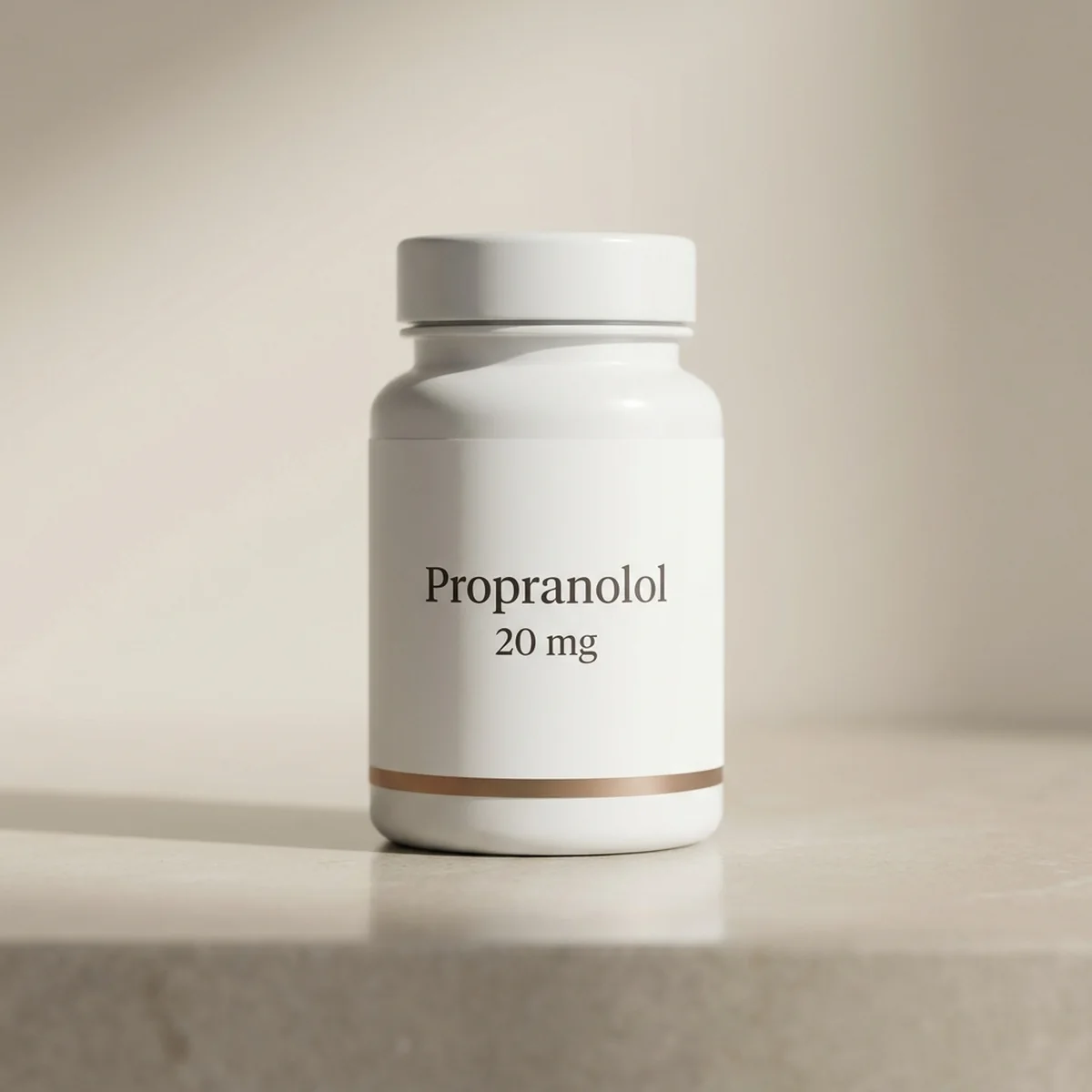
Propranolol 20 mg tablets after a licensed provider's review. Approved for other conditions; use for performance anxiety is off-label. Filled by a US-licensed pharmacy and shipped free.
From $107/mo with the 12-month plan and auto-refill
How would you like to pay?
Choose your plan
Prescription treatment requires an online medical evaluation. A provider decides whether treatment is appropriate; approval is not guaranteed.
Product details
Your plan
A licensed provider reads your health intake, including heart rate, asthma, diabetes and the medicines you take, decides if propranolol is right for you and chooses the dose.
Propranolol 20 mg tablets, dispensed by a US-licensed pharmacy after approval.
Delivered to your door at no added cost.
Pay once, or turn on auto-refill and take 10% off. Change or cancel refills anytime.
A printable decision pack and a plain checklist for reading a study.
Help with your order and delivery when you need it.
How it works
Pick 1, 3, 6 or 12 months. Auto-refill takes 10% off each plan.
Answer a private online questionnaire. A licensed provider reviews it and chooses the dose.
If prescribed, the pharmacy fills your order and ships it to you free.
Why people choose it
Each card links to the original study, with a tag for the kind of evidence behind it.
The label for propranolol hydrochloride tablets lists hypertension, angina pectoris, atrial fibrillation, myocardial infarction, migraine prophylaxis, essential tremor, hypertrophic subaortic stenosis and pheochromocytoma among its indications. None of them is performance anxiety.
Read the study Approved labelThe label's Angina Pectoris warning says there have been reports of exacerbation of angina and, in some cases, myocardial infarction, following abrupt discontinuance of propranolol therapy.
Read the study Small human studyIn a randomized, double-masked, crossover study, 5 ophthalmology residents took propranolol 40 mg or placebo 1 hour before microsurgery. By their own ratings propranolol decreased anxiety (P = .0058) and tremor (P < .0001), and the abstract states it is unknown whether outcomes improved.
Read the study Controlled human trialIn a double-blind pilot, 40 mg of propranolol (n = 40) or placebo (n = 20) was given before a speech task. Distress and anxiety measures fell clearly after treatment, but propranolol did not reliably outperform placebo.
Read the studyThe honest version
Trials of propranolol for performance anxiety are mostly small and mixed, and reviews describe the evidence as lacking or insufficient. Here is what the sources say, including where trials found no benefit.
See every study we trackA systematic review and meta-analysis of beta-blockers for anxiety disorders concluded that the quality of evidence for the efficacy of propranolol at present is insufficient to support the routine use of propranolol in the treatment of any of the anxiety disorders.
SourceA systematic review and meta-analysis of placebo-controlled randomized trials of pharmacotherapy for social anxiety disorder states that evidence for the efficacy of beta-blockers in treating performance anxiety was lacking.
SourceNIMH says beta-blockers are commonly the medication of choice for the “performance anxiety” type of social anxiety disorder.
SourceIn a randomized, double-masked, crossover study of 5 ophthalmology residents who took propranolol 40 mg or placebo 1 hour before microsurgery, the residents' own ratings showed a highly significant effect of propranolol in decreasing anxiety (P = .0058) and surgical tremor (P < .0001); the abstract states it is unknown whether decreased tremor and anxiety improved surgical outcome.
SourceA double-blind pilot study of propranolol 40 mg (n = 40) or placebo (n = 20) before a speech task reports that self-reported speech distress and questionnaire measures of public speaking anxiety showed clear reductions following treatment, but propranolol did not reliably outperform placebo regardless of speech duration at treatment.
SourceA study of beta blockers and speakers' performance and memory reports that propranolol impaired recall of difficult items in the memory of anxious subjects.
SourceA laboratory stress study states that prior findings are surprisingly mixed about whether beta-blockade (e.g., propranolol) blunts subjective stress, with many studies reporting no effects.
SourceFAQ
The things people ask most before starting Propranolol 20 mg.
Propranolol 20 mg tablets, after a licensed provider's review. Your provider chooses the dose. A US-licensed pharmacy dispenses your order and ships it free.
Propranolol paid once: $149 for 1 month, $402 for 3 months, $760 for 6 months or $1,430 for 12 months. With auto-refill each is 10% off: $134, $361, $684 and $1,287 ($107.25 a month on the 12-month plan). Shipping is free, and the exact total is shown before you pay.
Yes. You complete an online health intake, including your heart, breathing and the medicines you take, and a licensed provider decides whether propranolol is right for you and chooses the dose. Choosing a plan does not guarantee a prescription.
Yes, for other conditions. The label for propranolol hydrochloride tablets lists hypertension, angina pectoris, atrial fibrillation, myocardial infarction, migraine prophylaxis, essential tremor, hypertrophic subaortic stenosis and pheochromocytoma among its indications, and Drugs@FDA lists an original approval for Inderal (propranolol hydrochloride) dated 11/13/1967. Performance anxiety is not among the listed indications. NIMH says health care providers may prescribe beta-blockers off-label to treat short-term anxiety symptoms, even though the medication is not approved for that specific purpose, and an FDA patient page says that if you and your healthcare provider decide to use an approved drug for an unapproved use, FDA has not determined that the drug is safe and effective for the unapproved use.
The label says that when access to beta-receptor sites is blocked by propranolol, the chronotropic, inotropic, and vasodilator responses to beta-adrenergic stimulation are decreased proportionately. A review abstract on catecholamines in anxiety describes the use of beta-adrenergic blocking agents to diminish somatic symptoms attending anxiety-provoking situations, and a study in string players concluded that the beneficial effects of beta blockade in stage fright only involve a peripheral site of action. These are proposals, not proof of how it works in a particular person.
The sources are mixed. In a randomized crossover study of 5 ophthalmology residents, propranolol 40 mg decreased the residents' own ratings of anxiety and tremor before microsurgery, and it is unknown whether surgical outcome improved. In a double-blind pilot for fear of public speaking, propranolol 40 mg did not reliably outperform placebo. A study of speakers reported that propranolol impaired recall of difficult items in anxious subjects. Trials in musicians often tested other beta blockers, such as oxprenolol, atenolol or nadolol. A systematic review and meta-analysis concluded that the quality of evidence for propranolol is insufficient to support routine use in any of the anxiety disorders, and another states that evidence for beta-blockers in treating performance anxiety was lacking. NIMH says beta-blockers are commonly the medication of choice for the performance anxiety type of social anxiety disorder.
The label lists adverse events by body system, including bradycardia, hypotension, light-headedness, mental depression manifested by insomnia, lassitude, weakness and fatigue, vivid dreams, nausea, vomiting and diarrhea, and says that for immediate-release formulations fatigue, lethargy and vivid dreams appear dose-related. It gives no percentages in the passages we reviewed. A general FDA consumer page on managing the benefits and risks of medicines says to know what to do if you experience side effects and when to notify your doctor.
The label says propranolol is contraindicated in cardiogenic shock; sinus bradycardia and greater than first degree block; bronchial asthma; and in patients with known hypersensitivity to propranolol hydrochloride.
The label's Angina Pectoris warning says there have been reports of exacerbation of angina and, in some cases, myocardial infarction, following abrupt discontinuance of propranolol therapy, and that when discontinuance is planned the dosage should be gradually reduced over at least a few weeks. A general FDA consumer page on managing the benefits and risks of medicines says that if you stop the medicine or want to use the medicine differently than directed, you should consult with your health care professional. These statements do not say how they apply to occasional use.
The label says beta-adrenergic blockade may prevent the appearance of certain premonitory signs and symptoms (pulse rate and pressure changes) of acute hypoglycemia, especially in labile insulin-dependent diabetics. It says alcohol, when used concomitantly with propranolol, may increase plasma levels of propranolol. The label also lists interactions with drugs that affect CYP2D6, 1A2 or 2C19 pathways, verapamil, clonidine, NSAIDs and warfarin.
The label states that there are no adequate and well-controlled studies in pregnant women, that intrauterine growth retardation, small placentas, and congenital abnormalities have been reported in neonates whose mothers received propranolol during pregnancy, and that propranolol should be used during pregnancy only if the potential benefit justifies the potential risk to the fetus. It says propranolol is excreted in human milk and caution should be exercised when it is administered to a nursing woman.
A MedlinePlus health topic on poisoning says that if you suspect someone has been poisoned, you should call your local poison control center at 1-800-222-1222 right away, and NIMH says that in life-threatening situations you should call 911. An observational review of UK poison centre enquiries about intentional propranolol overdoses states that propranolol poisoning can be serious, difficult to treat and potentially fatal. If you or someone you know is struggling or having thoughts of suicide, NIMH says you can call or text the 988 Suicide & Crisis Lifeline at 988.
NIMH says cognitive behavioral therapy (CBT), a research-supported type of psychotherapy, is commonly used to treat social anxiety disorder, and NCCIH says anxiety disorders are generally treated with psychotherapy, medication, or both. NIMH also says that with benzodiazepines some people build up a tolerance and need increasing doses to get the same effect, and that some people even become dependent on them.
No. You can pay once for 1, 3, 6 or 12 months, or turn on auto-refill and take 10% off. You can change or cancel refills anytime.